
NIPT
Illumina NIPT Test
The Illumina NIPT Test is a highly accurate, non-invasive prenatal screening test that can be taken from as early as 10 weeks of pregnancy. Using a simple blood draw from the mother, Illumina NIPT analyses cell-free DNA in the blood to screen for common chromosomal conditions — with no risk to your baby.


What Illumina NIPT Screens For
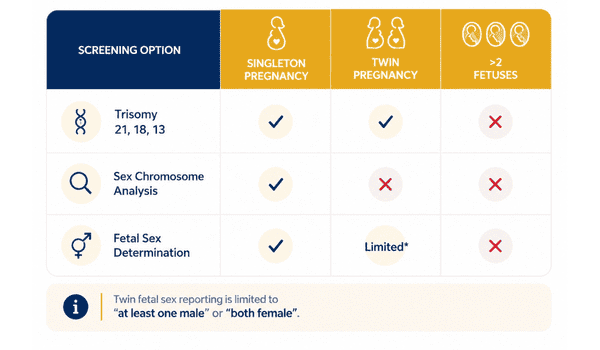
Illumina NIPT can detect:
The Illumina NIPT can detect the most common chromosomal conditions, giving you early insights into your baby’s health:
Trisomy 21 (Down syndrome): the most common trisomy at birth, associated with intellectual disabilities and sometimes heart or digestive conditions. Many people with Down syndrome live well into adulthood.
Trisomy 18 (Edwards syndrome): a rare condition often associated with miscarriage and severe medical complications. Most affected babies do not survive beyond the first year of life.
Trisomy 13 (Patau syndrome): another rare condition, linked to multiple birth defects and high rates of miscarriage, with most affected babies not surviving beyond infancy.
Sex chromosome conditions (optional): these occur when there is a missing, extra, or altered X or Y chromosome. They include Turner syndrome (X), Klinefelter syndrome (XXY), Triple X (XXX), and XYY.
Fetal sex determination (optional, no additional cost).
How accurate is Illumina NIPT?
Illumina NIPT is more accurate than traditional first-trimester screening methods (ultrasound and maternal serum testing) for detecting trisomy 21, 18, and 13. This means fewer false-positive and false-negative results, giving you greater confidence in your results.
It’s important to remember that NIPT is a screening test, not a diagnostic test. In rare cases, differences between the DNA from the placenta and the fetus can affect results.
If a high-risk result is reported, your doctor may recommend follow-up diagnostic testing — such as chorionic villus sampling (CVS) or amniocentesis — to confirm whether your baby is affected.

SUITABLE FOR MOST PREGNANCIESWho can have the Illumina NIPT?
The Illumina NIPT can be ordered by a healthcare professional for women who are at least 10 weeks pregnant.
It is suitable for:
-
Singleton pregnancies
-
Twin pregnancies (conceived naturally or by IVF, with your own egg or a donor egg)
Important notes for twin pregnancies:
-
Illumina NIPT can determine fetal sex but not sex chromosome conditions.
-
Results will be reported as one combined outcome:
-
If male → one or both twins are male
-
If female → both twins are female
-
-
Illumina NIPT is not suitable if there is a vanishing twin.
What Illumina NIPT does not assess:
-
Mosaicism
-
Partial trisomies
-
Translocations

UNDERSTANDING THE LIMITS OF NIPTLimitations of the Illumina NIPT
Like all NIPT methods, the Illumina NIPT has certain limitations. It is important to remember that NIPT is a screening test, not a diagnostic test.
Not suitable for:
-
Pregnancies with more than two fetuses
-
Cases of vanishing twin or fetal demise
-
Mosaicism, partial trisomies, triploidy, or translocations
-
Maternal conditions such as aneuploidy, transplant, or malignancy
Illumina NIPT also does not detect neural tube defects.
Special notes for twin pregnancies:
-
A high-probability result applies to at least one fetus
-
A male result means one or both twins are male
-
A female result means both twins are female
Accuracy considerations:
-
A low-probability result does not guarantee that a baby is unaffected
-
Rarely, a baby without a condition may receive a high-probability result
-
In cases of high-probability results — or if there are other clinical indications — confirmatory testing (such as CVS or amniocentesis) is required for a diagnosis
FAST RESULTS, WITH CONTINUED PREGNANCY CAREWhen will I get my Illumina NIPT results?
Results from the Illumina NIPT are usually available within 5-7 working days (from the time your sample is received at the laboratory).
You will still have your routine 12-week ultrasound scan, where your doctor can examine your baby’s anatomy in detail — including measurements such as nuchal translucency and nasal bone, along with other important checks.
At this visit, your healthcare provider can discuss both your DNA results and your ultrasound findings with you. Based on this information, you can decide together whether further testing, such as chorionic villus sampling (CVS) or amniocentesis, is necessary.

TRUSTED CARE, CLOSE TO HOMEOur Clinic Network
We work with trusted clinics across Ireland to make NIPT accessible wherever you are. Find the clinic that feels right for you, and connect directly to book your appointment with confidence.
Number Of Clinics:
0

Powered by HTS Labs in partnership with ISO15189-accredited laboratories in Europe, the UK & US.

LOCATION
Unit H9, Maynooth Business Campus, Maynooth, Co Kildare W23 NY98
CONTACT
nipt@htslabs.ie
01-9012000
©2026 NIPT.ie | All Rights Reserved