
NIPT
Panorama NIPT Test
The Panorama® Test is a highly accurate, non-invasive prenatal screening test that can be taken from as early as 9 weeks of pregnancy. Using a simple blood draw from the mother, Panorama analyses cell-free fetal DNA to screen for common chromosomal conditions — with no risk to your baby. Unlike other NIPTs, Panorama uses a unique technology that can distinguish between maternal and fetal DNA, helping to provide clear, reliable results.


What Panorama Screens For
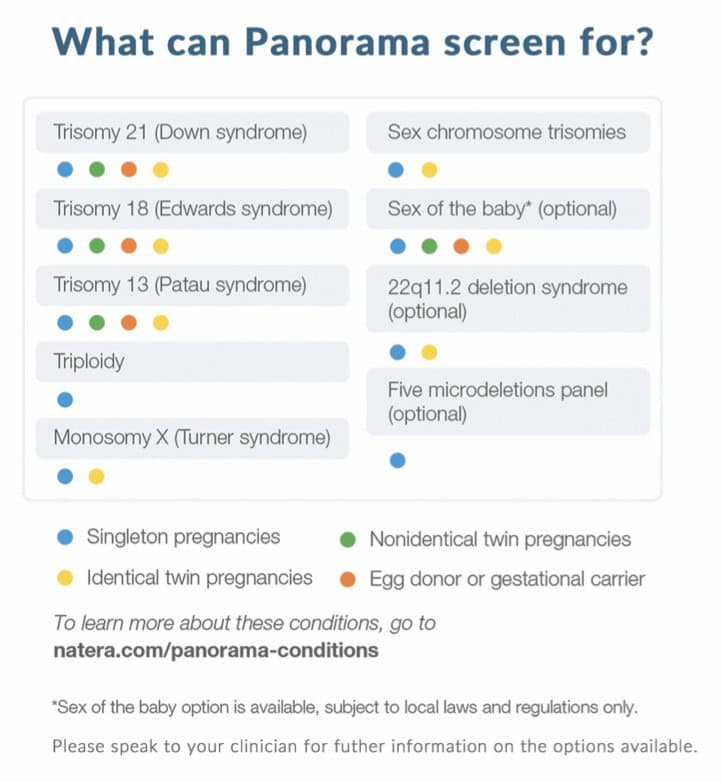
Panorama can detect:
-
Trisomy 21 (Down syndrome)
-
Trisomy 18 (Edwards syndrome)
-
Trisomy 13 (Patau syndrome)
-
Monosomy X (Turner syndrome)
-
Sex chromosome trisomies (XXY, XXX, XYY)
-
Triploidy
-
22q11.2 deletion syndrome (DiGeorge syndrome) — optional
-
Five microdeletions panel — optional
-
Fetal sex determination — optional
What is the Panorama Test?
The Panorama® Test is a non-invasive prenatal screening test (NIPT) that provides early and reliable insights into your baby’s health. With just a simple blood sample from the mother, Panorama analyses cell-free DNA to look for certain chromosomal conditions — all with no risk to the pregnancy.
Panorama is unique among NIPTs because it can distinguish between maternal and fetal DNA. This allows for highly accurate results and additional insights that other tests may not provide.
The test can be performed from as early as 9 weeks of pregnancy.

TRUSTED BY DOCTORS, CHOSEN BY PARENTSWhy choose Panorama?
The Panorama® Test is one of the most widely used NIPTs in the world and is especially popular in the United States. It only requires a simple blood draw from the mother and provides results with no risk to your baby.
What makes Panorama unique is its ability to separate the mother’s DNA from the baby’s DNA during analysis. This advanced technology helps deliver:
-
Fewer false positives (incorrect “high-risk” results)
-
No fetal sex errors in clinical validation studies
-
Clear, reliable insights you can trust
With its proven accuracy and unique scientific approach, Panorama is a safe and dependable choice for expectant parents seeking peace of mind.

What does a low-risk Panorama result mean?
A low-risk result means that it is very unlikely your baby has one of the conditions screened for by Panorama. For most conditions, the chance is less than 1 in 10,000.
It’s important to remember that no screening test can rule out all possible conditions, but a low-risk result is highly reassuring and means that further testing is usually not needed.
What if I receive a high-risk Panorama result?
It’s important to remember that Panorama is a screening test, not a diagnostic test. A high-risk result means your pregnancy has a higher chance of a specific genetic condition, but it does not confirm that your baby has the condition.
If you receive a high-risk result, your healthcare provider will guide you through the next steps, which may include:
-
Genetic counselling to discuss the result in detail
-
Detailed ultrasound scans
-
Diagnostic testing such as chorionic villus sampling (CVS) or amniocentesis, which can confirm whether the condition is present
All medical decisions should be made in partnership with your healthcare provider, using the most accurate information available.
Are there other types of results with Panorama?
Yes. In some cases, Panorama may not return a clear result on the first attempt. This happens in about 1 in 65 tests. If this occurs, your healthcare provider may recommend a second blood draw to try the test again.
In rare cases, Panorama may also provide results that relate to the mother’s genetics or physical health, rather than the baby’s. If this happens, your healthcare provider will explain what the finding means and guide you on the next steps.

TRUSTED CARE, CLOSE TO HOMEOur Clinic Network
We work with trusted clinics across Ireland to make NIPT accessible wherever you are. Find the clinic that feels right for you, and connect directly to book your appointment with confidence.
Number Of Clinics:
0

Powered by HTS Labs in partnership with ISO15189-accredited laboratories in Ireland, Europe, the UK & US.

LOCATION
Unit H9, Maynooth Business Campus, Maynooth, Co Kildare W23 NY98
CONTACT
nipt@htslabs.ie
01-9012000
©2025 NIPT.ie | All Rights Reserved